
AVC Contributions 2025: €175 Billion Is Sitting in Irish Bank Accounts Earning Nothing
AVC Contributions 2025: €175 Billion Is Sitting in Irish Bank Accounts Earning Nothing. The Deadline Is 31st October.
QUICK ANSWER
Central Bank data puts Irish household deposits at €174.9 billion as of June 2026, most earning close to 0% interest. If you are a higher-rate taxpayer who has not used your full 2025 pension contribution limit, a once-off AVC - an Additional Voluntary Contribution - lets you claim income tax relief against last year's income, but only if paid before 31st October 2026 (or 18th November 2026 via ROS). A €20,000 AVC at 40% relief costs €12,000 net, turning into €20,000 in your pension from day one: a 66.7% uplift before any investment growth. Miss the date and the 2025 relief is gone for good.
The Number Behind This - and Why It Matters to You
€174.9 billion. That’s what Irish households held on deposit as of June 2026, according to the Central Bank, up €9 billion in six months. Most of it sits in accounts paying 0–1%, well under inflation, quietly losing value every month. If part of that is yours, the next six weeks, before 31st October, are the narrowest window you will get this year to act.
It's also the real answer to the thing we hear most from clients “I'm paying too much tax”. A chunk of what you've already handed over to Revenue can come back to you. Not a loophole. Just relief you're entitled to that expires, unclaimed, every year.
Who This Is For
High earners who don't yet feel wealthy, because the net worth is tied up in a mortgage, a career, or cash in the bank.
Public servants, professionals and directors on the 40% rate whose pension has never been actively optimised.
Irish tech employees, where salary, bonus and equity push you into the higher band while the pension sits on autopilot.
The self-employed, with no employer scheme doing this for you.
Anyone with deposit cash earning next to nothing while inflation and DIRT eat away at it.
What Is an AVC Contribution?
An AVC, short for Additional Voluntary Contribution, is extra money you pay into your pension on top of what you normally put in. A single premium AVC is a once-off lump sum, the mechanism for claiming relief you were owed in a year that's already ended.
Employees and directors in an occupational scheme use an AVC or an AVC PRSA. If you're self-employed, you use a personal pension or PRSA instead. The relief, the age-related limits and the deadline are all identical. Only the product wrapper changes.
The Mechanism: An Immediate 66.7% Uplift
Revenue gives you income tax relief at your marginal rate, 20 or 40 percent, on contributions up to an age-related limit. Most people contribute something through payroll, but few max it out. Whatever's left unused is relief you're owed and haven't claimed.
Take a 40-year-old earning €100,000 who put in 5% (€5,000) in 2025. At 40, the limit is 25% of salary, which is €25,000, leaving €20,000 of unused relief. Pay that as a single premium AVC before the deadline, and here's what happens:
| Amount | |
|---|---|
| AVC contribution | €20,000 |
| Tax relief at 40% | €8,000 |
| Real net cost | €12,000 |
| Now in the pension | €20,000 |
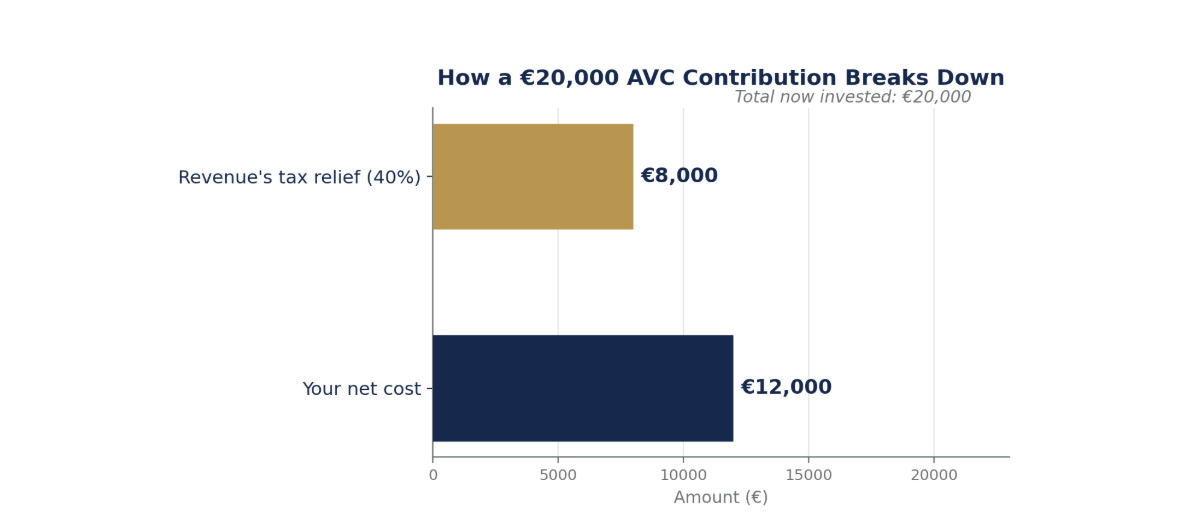
€12,000 of cash becomes €20,000 of pension asset on day one. A gain of €8,000, or 66.7%.
One thing worth being clear about: this isn't an investment return. It's after-tax cash converting into a pre-tax contribution under Revenue's rules, fixed by legislation, not markets. What that €20,000 does next depends on how it's invested, and it can fall as well as rise. Which is exactly why idle deposit cash, earning next to nothing and taxed through DIRT, is such a natural source for it.
How Much Can You Actually Put In?
Your maximum is an age-related percentage of salary, capped at earnings of €115,000 regardless of what you actually make.
| Age | Maximum % of earnings |
|---|---|
| Under 30 | 15% |
| 30–39 | 20% |
| 40–49 | 25% |
| 50–54 | 30% |
| 55–59 | 35% |
| 60 and over | 40% |
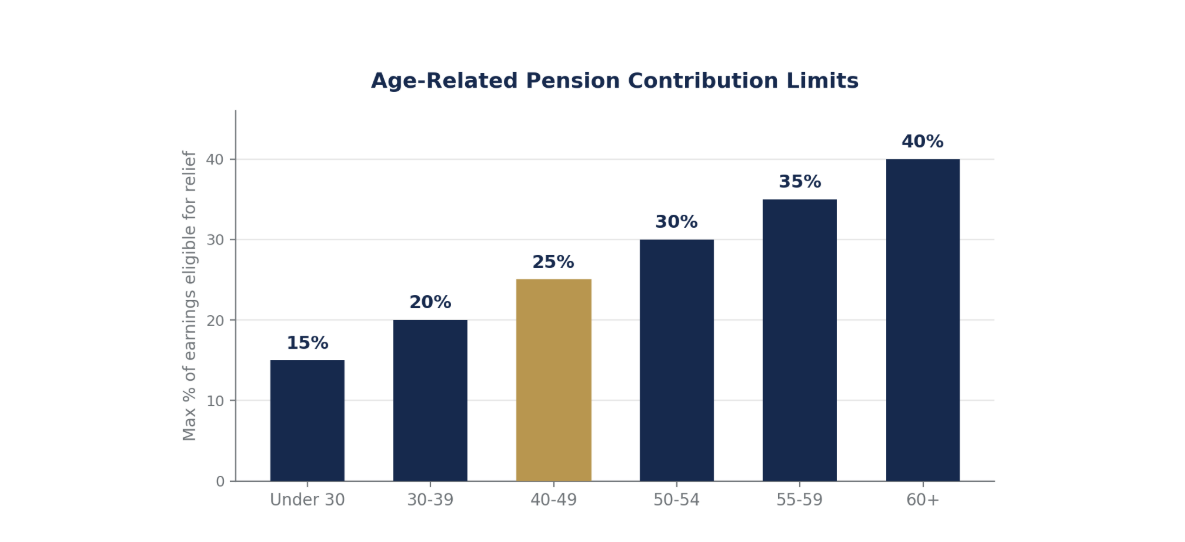
Two catches worth knowing. First, the percentage covers everything already contributed. Ten percent used at 45 leaves 15% of headroom, not 25%. Second, the €115,000 cap applies regardless of income, so €160,000 earned at age 50 is still capped at 30% of €115,000, which is €34,500. The self-employed use the same bands and the same cap, just through a personal pension or PRSA.
The Deadline, and What Missing It Costs
| Filing method | Deadline for 2025 relief |
|---|---|
| Paper return | 31st of October 2026 |
| ROS, filed and paid online | 18th of November 2026 |
The ROS extension needs both the return and payment made online - do only one, and 31st of October stands. Miss the window entirely and the 2025 relief is gone for good, not deferred. Your next chance is against 2026 income, and that deadline doesn't land until the end of October 2027, roughly a year with no equivalent opportunity. That's what "use it or lose it" means in practice.
Give yourself more time than you think you'll need. Confirming your headroom, choosing the right structure, and getting provider and trustee sign-off all take days, not minutes. Leaving it to the last week of October is the single most common reason people miss relief they were entitled to.
Why This Builds Real Wealth, Not Just a Refund
The relief gets you in the door. Once it's inside the pension, the fund grows free of income tax, DIRT, exit tax and Capital Gains Tax for as long as it stays invested, and that untaxed compounding typically dwarfs the initial relief over ten, twenty or thirty years. At retirement, it can top up your tax-free lump sum, fund an Approved Retirement Fund, or close a gap against Revenue's maximums. It's one of the more underused wealth-building levers in Ireland, and it depends on nothing more than a decision made before a fixed date.
Frequently Asked Questions
I'm self-employed, does this apply to me?
Yes, through a PRSA rather than an AVC. Same age bands, same €115,000 cap, same deadline.
How do I find my actual unused relief?
It depends on your exact salary, age and every contribution already made in 2025. Worth confirming precisely before committing an amount.
Is the 66.7% figure guaranteed?
The relief itself is fixed by Revenue's rules and your marginal rate. What the fund does afterwards depends on investment performance, which can rise or fall..
Can I use money already on deposit?
Yes. That's exactly what this is built for, redirecting idle, near-zero-yield deposit cash into an AVC contribution before the deadline..
What happens if I miss 31st of October deadline?
The 2025 relief is lost for good. Your next chance is against 2026 income, with its own deadline not landing until the end of October 2027..
Next Step: Get Your Own Number Before Late October
Your own unused relief depends on your salary, age, contributions and structure, and it's worth confirming with enough time left to actually process it before the deadline.
LIMITED-TIME CONSULTATION
For a limited period, between now and the last week of October 2026, we're offering a dedicated €99 consultation built around this deadline: We'll confirm your unused relief, the right structure and get things moving in time to bank the relief and invest it properly.
Book your consultation: calendly.com/daniel-fpms/avc-consultation
Or email advice@fpms.ie
October fills up fast, so earlier is genuinely better.
Financial Planning Matters is a Irish-based financial planning practice regulated by the Central Bank of Ireland, working with professionals, company directors and self-employed clients across Ireland.
Sources:
Financial Planning Matters is regulated by the Central Bank of Ireland. This article provides general information and does not constitute financial, tax or legal advice. Tax treatment depends on individual circumstances and may change. The value of pension investments can fall as well as rise, and you may get back less than you invested. Figures are stated as at 2026 and should be confirmed at the time of any decision.