
AVC Contributions Part 2: €10,000 a Year From Age 40 to 60: The Full 20-Year Picture, and How to Actually Do It
AVC Contributions Part 2: €10,000 a Year From 40 to 60, the Full Picture
QUICK ANSWER
In Part 1, we covered claiming unused 2025 relief with a once-off AVC. This is what a full, ongoing commitment looks like instead. A 40-year-old higher-rate taxpayer contributing €10,000 a year (gross) to a regular AVC from age 40 to 60 gets €4,000 of tax relief each year. That's a net cost of €6,000 a year, €120,000 in total. Assuming 6% annual growth, the fund reaches €389,927 at age 60, and only €120,000 of that (31%) is money the person actually paid. The rest is Revenue's relief and investment growth. The same €6,000 a year left on deposit instead would be worth €120,000 nominally, and less than €81,000 once inflation is accounted for. The gap, almost €270,000, is the opportunity cost of not doing this.
The Set-Up
Same 40-year-old from Part 1, earning €100,000, already contributing 5% (€5,000) to their scheme. Committing €10,000 a year as a regular AVC, an ongoing payroll deduction, runs for 20 straight years, from 40 to 60.
Across that span, Revenue's age-related limit rises through three bands: 25% at 40–49, 30% at 50–54, and 35% at 55–59. €10,000 a year stays comfortably inside the limit throughout, with more headroom to spare, not less, the older this person gets.
Each €10,000 gross contribution attracts €4,000 of relief at 40%, so the real cost is €6,000 a year:
| Amount | |
|---|---|
| Total gross contributed (20 yrs) | €200,000 |
| Total tax relief received | €80,000 |
| Total net cost | €120,000 |
What the Fund Actually Does
Assuming 6% annual growth, net of charges (an assumption, not a guarantee), the balance builds like this:
| Age | Fund value |
|---|---|
| 40 (first contribution) | €10,600 |
| 45 | €59,753 |
| 50 | €139,716 |
| 55 | €246,725 |
| 60 (retirement) | €389,927 |
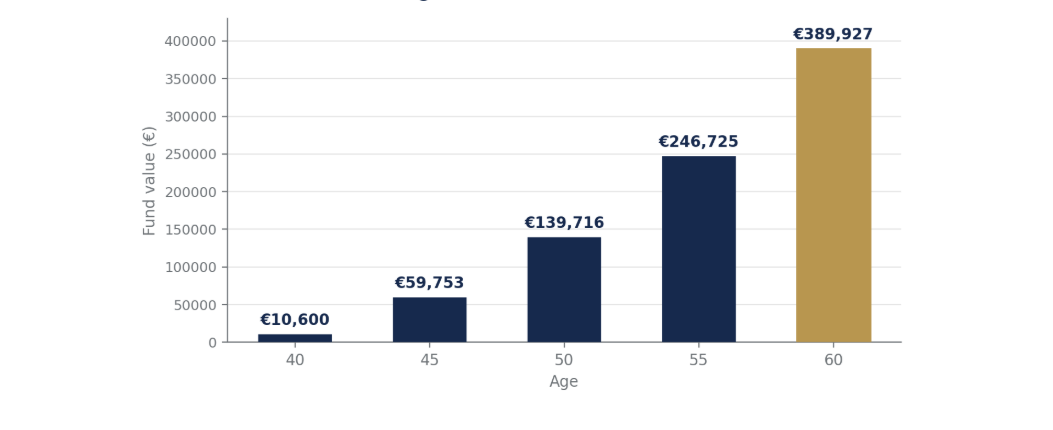
The fund almost triples between 50 and 60 alone, purely from the combination of continued contributions and compounding on everything already inside it. Set against the €120,000 actually paid net over the full 20 years, the fund at 60 is 3.25 times that outlay.
Where the €389,927 Actually Comes From
Break the final fund down into its three sources, and the case for taking control of this becomes hard to ignore:
| Source | Amount | Share |
|---|---|---|
| Your net cost | €120,000 | 30.8% |
| Revenue's tax relief | €80,000 | 20.5% |
| Investment growth (6% compounding) | €189,927 | 48.7% |
| Total fund at 60 | €389,927 | 100% |
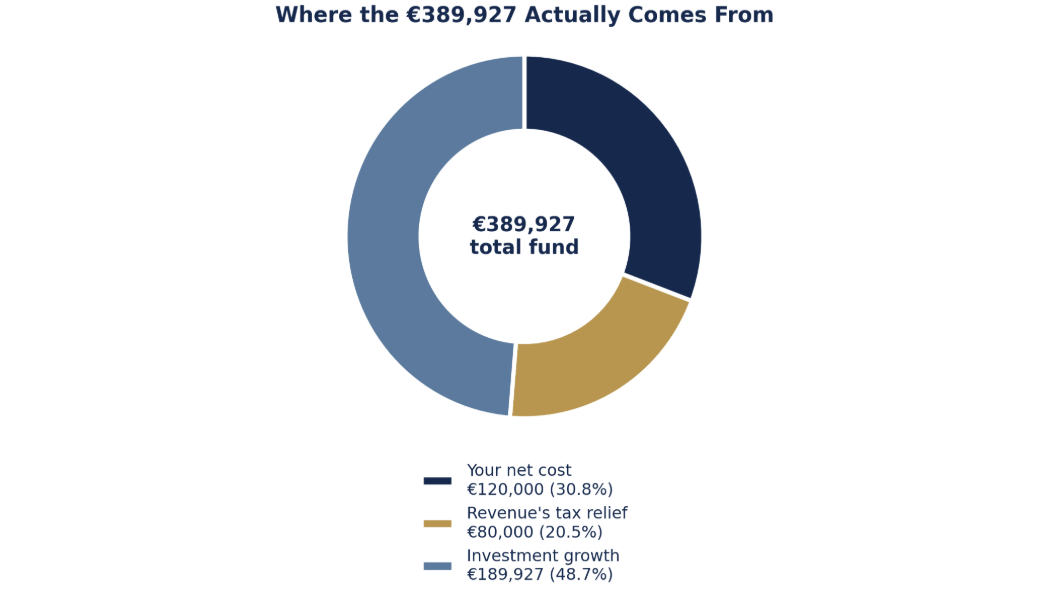
Less than a third of the final fund is money you actually paid. Almost half of it, more than everything you and Revenue put in combined, is investment growth on its own, generated simply because the money was invested rather than left sitting idle. That's the practical case for putting the tax rules to work for you: Revenue hands you €80,000 for free, then gives both that €80,000 and your own €120,000 twenty years to compound side by side.
The Opportunity Cost of Not Doing This
The same €6,000 a year, left in a deposit account earning close to nothing instead, would still be just €120,000 at 60, the nominal total paid in, having gone nowhere. But nominal isn't the full story. Assuming inflation averages a modest 2% a year, that €120,000 would only buy what roughly €80,757 buys today. It hasn't just failed to grow. It's lost close to a third of its real purchasing power while sitting there, eroded rather than invested
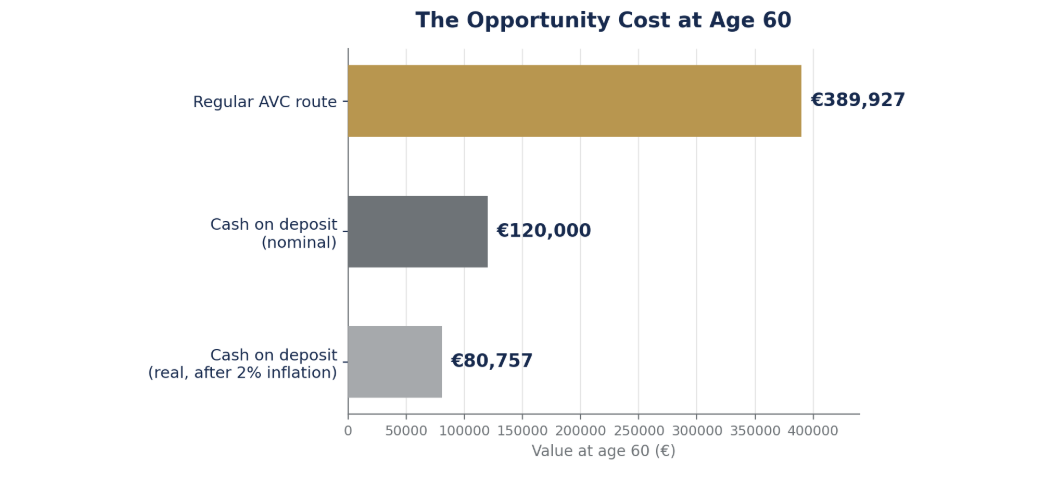
The gap between doing this and doing nothing is almost €270,000 in cash terms, and considerably more once inflation's effect on idle cash is factored in. That's the real difference between putting your money to work and leaving it on deposit to be quietly eaten away instead.
None of this is guaranteed. 6% growth and 2% inflation are illustrative assumptions, not forecasts. Actual returns and inflation both vary year to year, and depend on the funds chosen and wider economic conditions.
The Roadmap: How to Actually Set This Up
Confirm your real headroom, not just this year's. Check your age-related limit now and how it steps up over the years ahead. Most people have more room than they think, and it only grows with age.
Choose the right vehicle. If your employer's scheme has an AVC facility, set it up through payroll so relief is applied automatically. If it doesn't, your employer must give you access to an AVC PRSA instead. The relief and limits are identical either way.
Set it up as a standing instruction, not a yearly decision. A regular AVC deducted from every payslip removes the risk of "meaning to start" and never quite doing it.
Match the investment strategy to the time horizon. Twenty years is long enough to take a growth-oriented approach early on, then gradually de-risk as retirement approaches. This isn't a decision to make once and forget.
Review annually, not just at the start. Salary changes, scheme changes, and moving into a higher age band all change your headroom. Review at least once a year, ideally with an adviser.
Leave it invested. The single biggest driver of the outcome above isn't the contribution size. It's not touching the fund and letting compounding run uninterrupted for two decades.
Revisit your options as retirement nears. At 60, decide how the fund is drawn, whether that's a tax-free lump sum, an Approved Retirement Fund, or an annuity. Review it a year or two ahead, not on the day itself.
See What This Looks Like with Your Own Numbers
This example assumes one specific salary, age and contribution level. Yours will look different depending on your own income, age band and existing pension.
LIMITED-TIME CONSULTATION
For a limited period, we're offering a dedicated €99 consultation focused specifically on your AVC opportunity, to talk through the numbers and agree the next steps. We're closing the diary for this offer on 22 October 2026.
Book your consultation: calendly.com/daniel-fpms/avc-consultation
Or email advice@fpms.ie before the diary closes.
Financial Planning Matters is an Irish-based financial planning practice regulated by the Central Bank of Ireland, working with professionals, company directors and self-employed clients across Ireland.
Financial Planning Matters is regulated by the Central Bank of Ireland. This article provides general information and does not constitute financial, tax or legal advice. The 6% growth rate and 2% inflation rate used throughout are illustrative assumptions only and are not guaranteed. The value of pension investments can fall as well as rise, and you may get back less than you invested. Tax treatment depends on individual circumstances and may change. Figures are stated as at 2026 and should be confirmed at the time of any decision.